
 Nopalitos for the World
Nopalitos for the World · KupuriBiotech · Not operating; information only
For ranchers
Planned pilot. Nothing is planted, operating or for sale.

A note on the figures. The numbers on this page are either ranges reported in published research and technical references, or KupuriBiotech internal projections. None has been measured at Tilden. Every value appears in metric and U.S. customary units.
About the photographs. The images on this page are illustrative. They do not show the Tilden pilot, which has not been planted, nor KupuriBiotech operations, which have not begun.
For ranchers · Planting
From a cured pad to an established stand.
Establishment practice summarized from published literature. It is a field guide to read, not a recipe; the pilot will refine it with its own records.
Nopal is propagated from pads rather than seed, which makes establishment as much a matter of careful handling as of agronomy. A healthy, well-cured pad set into well-drained ground is the single most important decision of the first season.
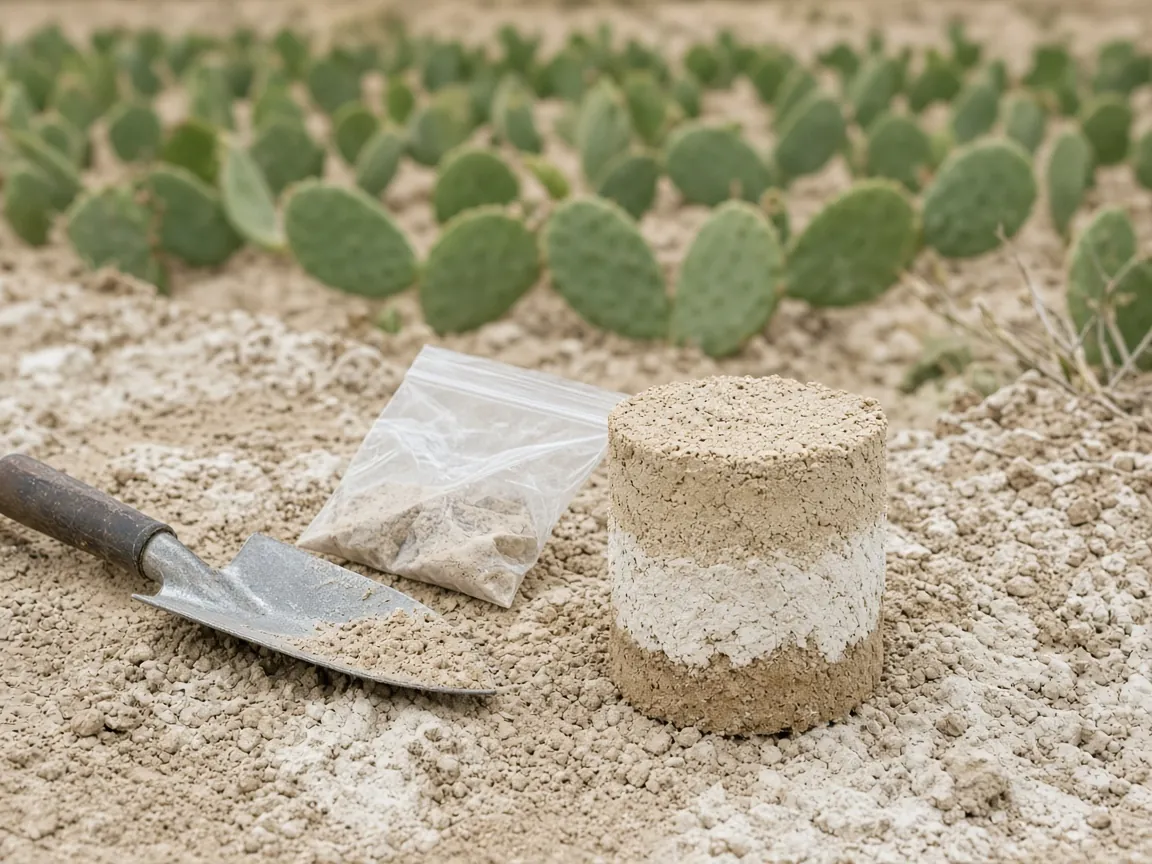
Before the first pad is planted, the site is characterized in detail: soil texture, pH, salinity, organic matter and nutrients, together with the chemistry of the irrigation water. Caliche, the hard calcareous layer common in South Texas, deserves particular attention, because it limits both rooting depth and drainage.
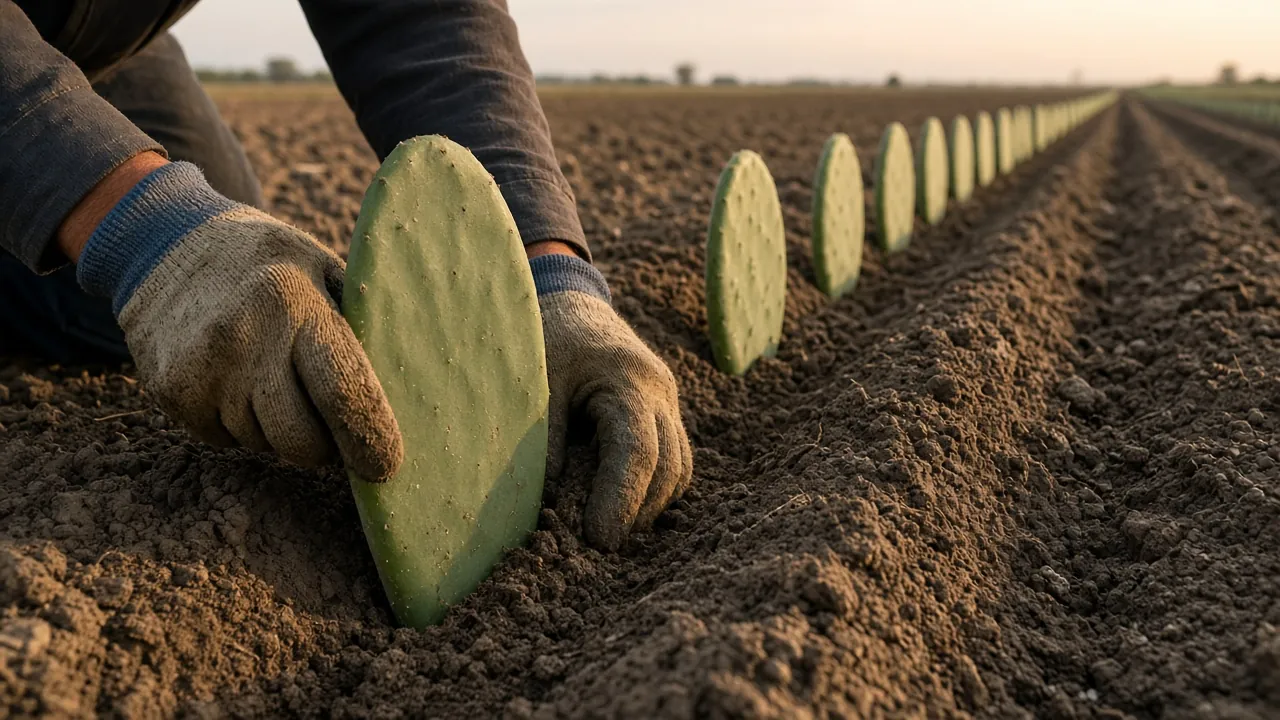
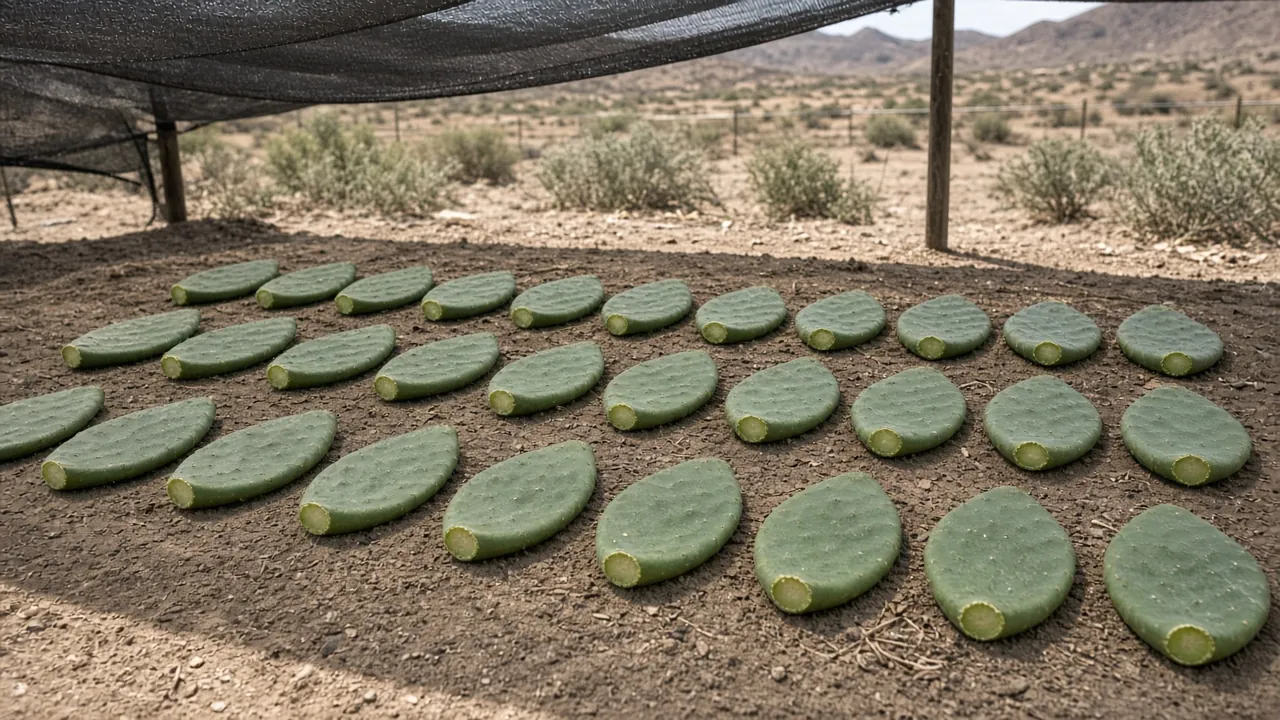
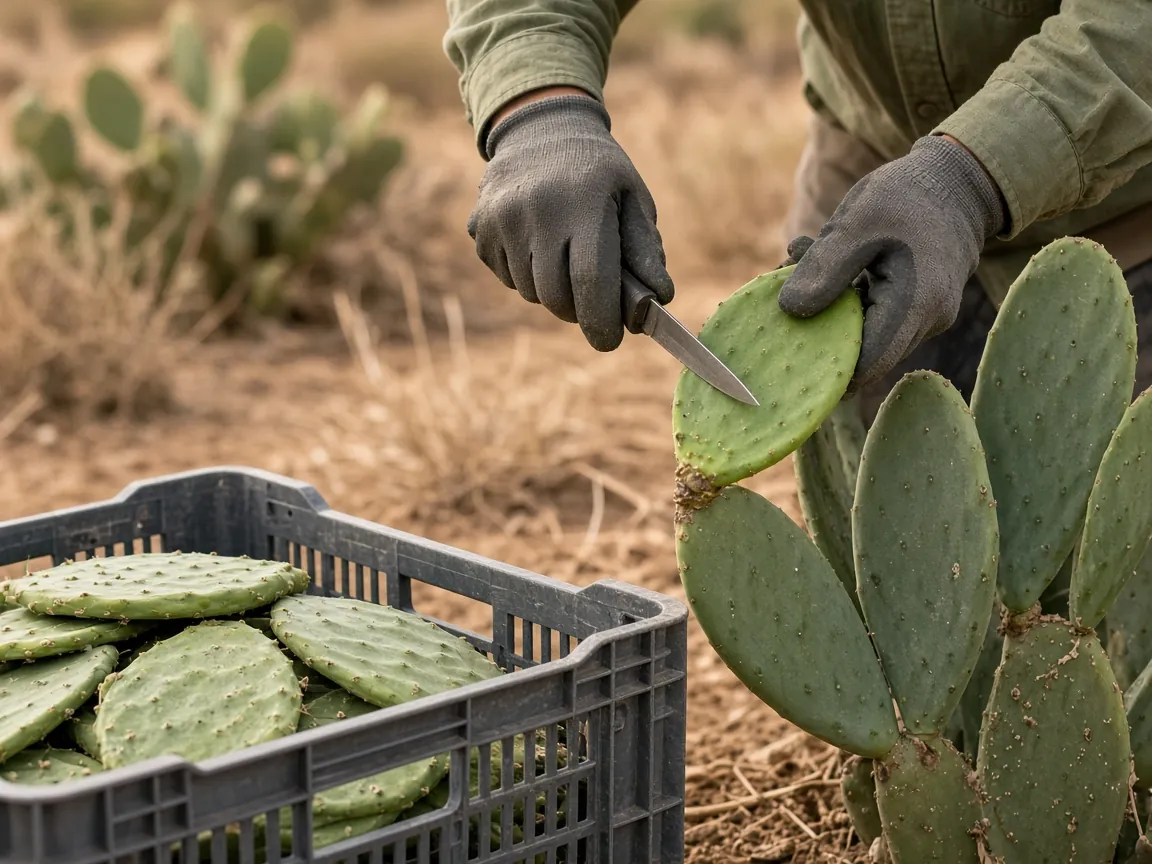
Founder pads are chosen for soundness and age, cut cleanly at the joint and cured in open shade so that the cut surface can heal before planting1. They are set upright, one-third to half buried, into dry soil, and irrigation begins once they have had time to settle, about two weeks in published practice2.
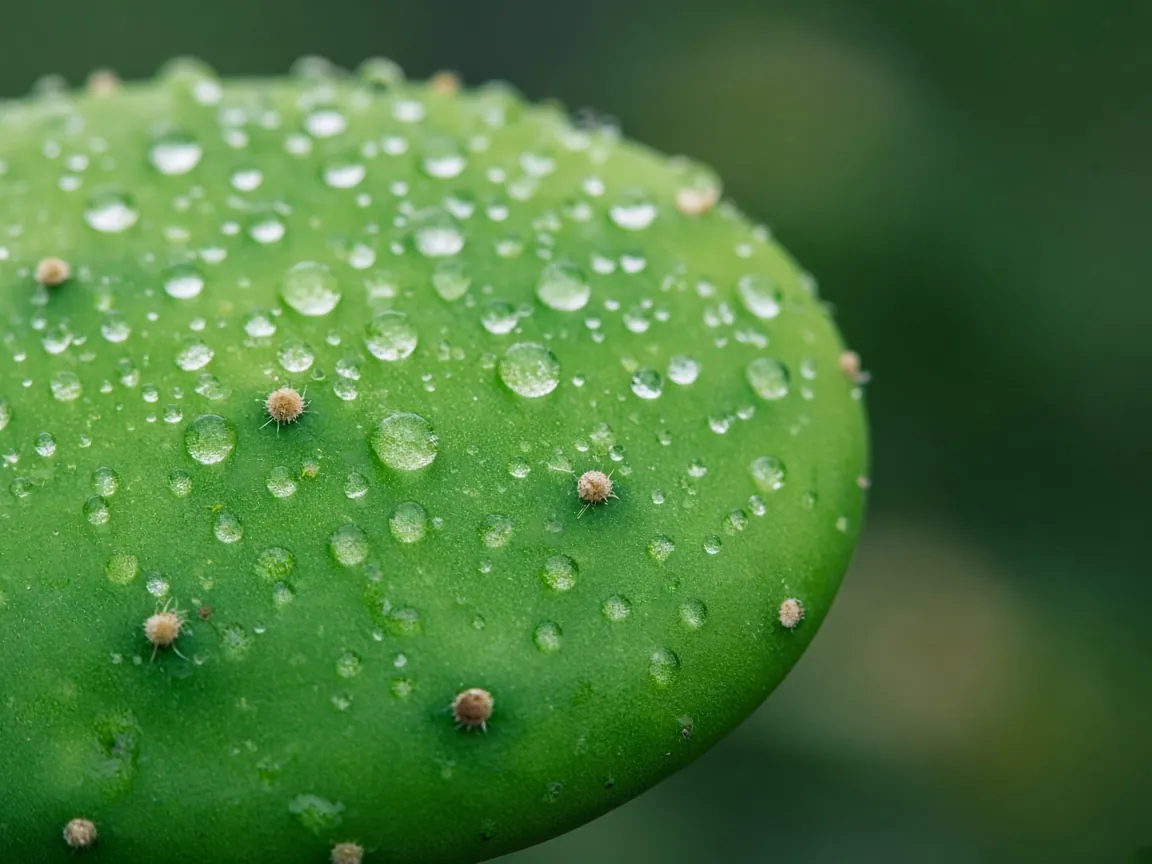 Illustrative image
Which nopal?
There are vegetable types, dual-purpose types and forage types. The variety for the pilot is a spineless forage type, still to be confirmed. Each incoming lot will be counted, photographed and identified as received, and its identity confirmed in the field as the plants develop.
Site baseline
Soil texture, pH, salinity, organic matter, nutrients, sodicity and depth to caliche or any root-limiting layer; irrigation-water chemistry. A totalizing water meter and a record system go in before planting.


Planting
One-third to half of each pad is buried, set upright, in dry soil21. Published layouts range from compact rows 0.8 m by 0.4 m (2.6 by 1.3 ft) to 2 m by 1 m (6.6 by 3.3 ft), with double-row designs such as 1 × 1 m rows and 5 m (16 ft) alleys2. A Mexican rainfed technical sheet plants from March to May4.


Fertility from the soil test
Nutrients are set from the soil analysis and must replace what harvested pads export1. Rates for the pilot will be fixed from site data.

For ranchers · Harvest cycle
Cut at the right age, then let it regrow.
In dual-purpose practice the age of a pad decides its use: tender young shoots for the table, shoots not cut for the table as green forage, and older pads left as the structure of the plant.
Harvest is where forage nopal rewards patience. The date of the first regular cut is to be confirmed at the pilot, once each plant has built enough structure to carry repeated harvests without being weakened. For reference, a Mexican rainfed technical sheet starts cutting six months to a year after planting4, and an irrigated trial found more forage when the first cut came later, between 4 and 16 months3.
From then on, pads are cut at the joint and the mother structure is left in place, so that regrowth, not the calendar, sets the date of the next harvest. Published practice varies widely: half-yearly cuts in high-density plantings, and one cut every two years or more in less dense stands2; rainfed palm stands in Brazil are cut every two to four years3.
Pad age and use
Young shoots can be harvested as a vegetable from about 8–10 days after they sprout; shoots not harvested for the table can be used as green forage2. Older pads become the structure the plant regrows from. The pilot will record the age and weight of the pads it cuts; we do not publish an age chart until then.
Pad length and thickness are from the botanical description of the common forage species1; pad mass is the usual range for most Opuntia varieties, and heavier pads are often found1. These are literature references, not measurements from the pilot.
 Illustrative image
Handling and storage
Whole pads keep for a short to medium period when held dry, shaded and ventilated, off wet ground; the pilot will measure that window under its own conditions. Chopped and fermented material is different: it is perishable and is meant to be used promptly.
For ranchers · Feeding
Fresh first: chopped, mixed, and offered with dry forage.
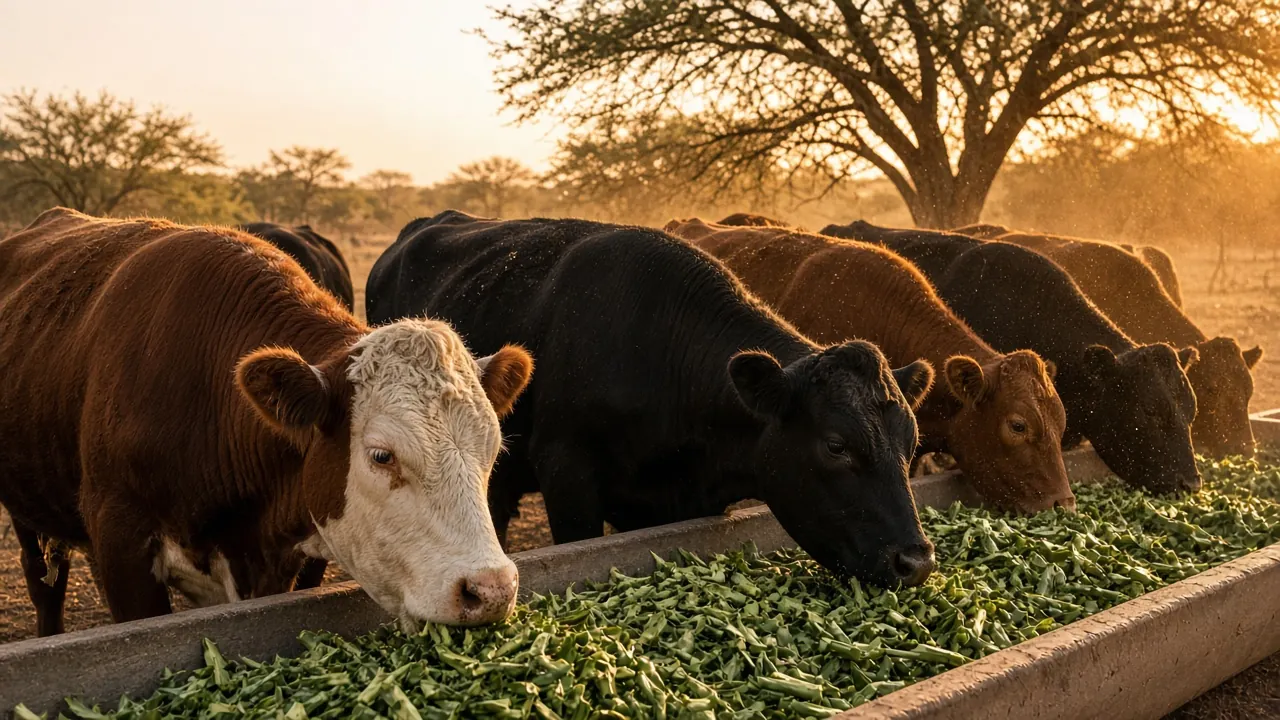
Cattle and other ruminants can eat spineless nopal fresh, with no processing beyond chopping. Enrichment is optional and comes later.
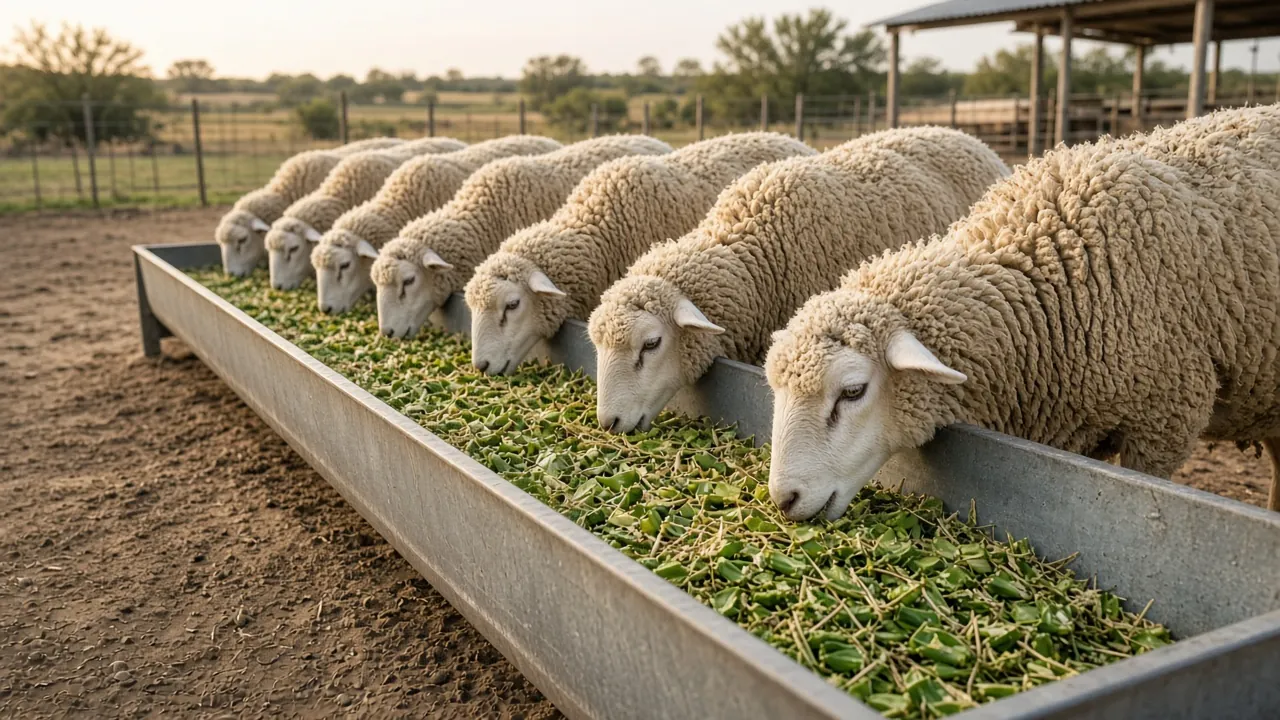
On the ranch, nopal is rarely fed on its own. Fresh pads are chopped and mixed with hay or other coarse forage, so that the ration keeps the physically effective fiber that ruminants need while the nopal contributes moisture and readily available energy. Spineless pads can be offered without the singeing that wild, heavily spined nopal requires.
In published lamb trials summarized by FAO, cactus made up about 28–70% of the diet dry matter, alongside straw or hay1. The same source warns that large amounts of low-dry-matter pads can cause diarrhoea and recommends pairing them with a fibrous feed1. These are references, not recommendations: rations belong to a qualified animal nutritionist who knows the herd, the season and the production goal.
 Illustrative image
 Illustrative image
Lambs: nopal in trial diets
% of diet dry matter · range across published trials
Cactus share of the lamb diets in FAO Table 4 (p. 84), calculated by us; in the trial with the highest share, the lambs did not gain weight1. A published reference, not a KupuriBiotech ration recommendation and not a result from the pilot.

Small ruminants and cattle
Sheep, goats and beef and dairy cattle are the livestock most often described with nopal-based rations in the literature.
Keep the fiber
High inclusions without enough physically effective fiber have been associated with loose feces. Rations are balanced with dry forage.
Formulated by a nutritionist
Any ration should be formulated by a qualified animal nutritionist for the specific herd and production goal.
Sources
Numbered references for the literature figures on this page. Each was checked against the page or table shown. KupuriBiotech internal projections are not literature and carry no reference.
- Inglese P., Mondragón C., Nefzaoui A. and Sáenz C. (eds.) (2017). Crop ecology, cultivation and uses of cactus pear. FAO and ICARDA, Rome. ISBN 978-92-5-109860-8. https://www.fao.org/4/i7628en/I7628EN.pdf. Cited at: p. 19; p. 79; p. 80; p. 83; Table 4, p. 84; p. 123.
- Martínez Hernández J. de J. (2023). Manual técnico del nopal: plantación y manejo agronómico del nopal forrajero en zonas áridas. Comisión Nacional de las Zonas Áridas (CONAZA), Mexico. https://0201.nccdn.net/1_2/000/000/116/883/manual-nopal.pdf. Cited at: p. 6; p. 40; p. 44; p. 49; p. 50.
- Rocha R. S., Voltolini T. V. and Gava C. A. T. (2017). Características produtivas e estruturais de genótipos de palma forrageira irrigada em diferentes intervalos de corte. Archivos de Zootecnia 66(255): 363–371. DOI 10.21071/az.v66i255.2512. https://www.alice.cnptia.embrapa.br/alice/bitstream/doc/1085862/1/Tadeu2017.pdf. Cited at: p. 364; Table II, p. 366.
- Medina García G., Salinas González H. and Rubio Aguirre F. A. (2001). Potencial productivo de especies forrajeras en el estado de Zacatecas. INIFAP, Libro Técnico No. 1. Technical sheet “Nopal forrajero, temporal” (rainfed forage nopal). https://zacatecas.inifap.gob.mx/publicaciones/Pot_Prod_de_Especies_Forrajeras_en_Zacatecas.pdf. Cited at: p. 54.