
 Nopalitos for the World
Nopalitos for the World · KupuriBiotech · Not operating; information only
The science
Planned pilot. Nothing is planted, operating or for sale.

A note on the figures. The numbers on this page are either ranges reported in published research and technical references, or KupuriBiotech internal projections. None has been measured at Tilden. Every value appears in metric and U.S. customary units.
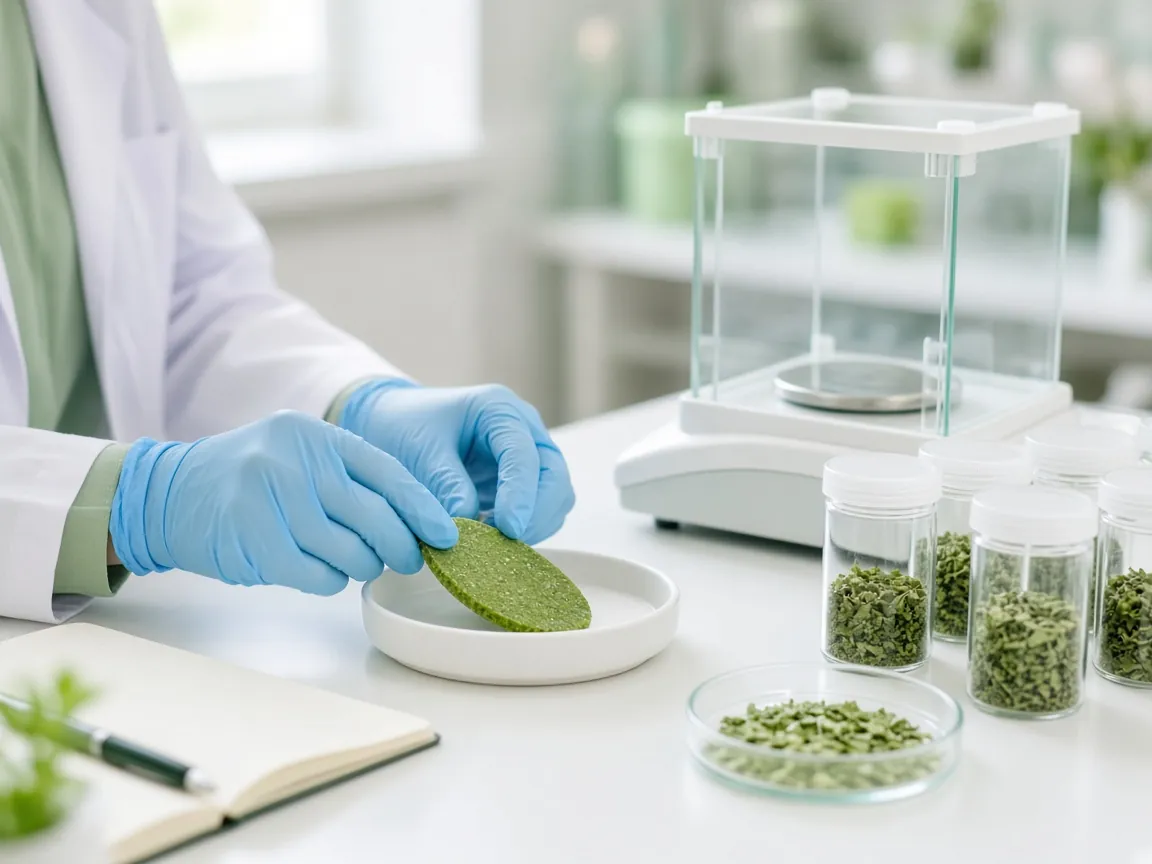
About the photographs. The images on this page are illustrative. They do not show the Tilden pilot, which has not been planted, nor KupuriBiotech operations, which have not begun.
We will measure before we speak, and never sell hope we cannot support with evidence.
Published research informs this work; it never replaces our own measurements. Every figure below says where it comes from.
The science · Nutrition
Nine parts water, one part dry matter.
Ranges from published analyses of other Opuntia materials; no pads from the pilot have been analyzed.
A fresh nopal pad is, roughly, nine parts water to one part dry matter1. That single fact shapes how its nutritional value should be read. Measured on a fresh-weight basis, the crude protein carried by a tonne of pads is modest; measured on a dry-matter basis, the picture becomes comparable with other feeds.
Its strengths lie elsewhere: water supplied with the ration in the driest months, readily fermentable carbohydrates, and a perennial supply that does not depend on reseeding. Its limits are equally clear, low fiber and low crude protein in the fresh pad, which is why it is combined with dry forage2 and why enrichment is of interest.
The pilot is planned to build its own laboratory profile, sampled at each harvest: dry matter, crude protein, fiber fractions and minerals. Until then, the values below are literature ranges and should be read as such.
Composition of a fresh pad
Typical ≈ 90% water / ≈ 10% dry matter · literature range1
Crude protein, % of dry matter
Fresh pads vs. after aerobic fermentation with added nitrogen · literature ranges
Crude protein = total nitrogen × 6.25. It is not true protein, and most of this rise comes from the nitrogen that is added (see Protein enrichment).
| Item (literature range) | Fresh pads | After fermentation |
|---|---|---|
| Dry matter, % of fresh weight | ≈ 6–14% (average ≈ 9%)1 | ≈ 8–11%34 |
| Crude protein, % of dry matter | ≈ 3–11% (average ≈ 7%)1 | ≈ 23–34% (two trials)43 |
| Crude protein per metric tonne fresh | ≈ 6 kg (from the averages) | ≈ 27 kg (one trial)3 |
| Crude protein per short ton fresh | ≈ 13 lb (from the averages) | ≈ 54 lb (one trial) |
Calculated from published analyses, not laboratory results from the pilot. Fresh-basis protein = (CP % of DM) × (DM %) / 100; fresh pads: 6.9% × 9.1% ≈ 0.63% ≈ 6.3 kg per tonne. The fermented values come from small published trials with added nitrogen.
The science · Protein enrichment
Enrichment by fermentation: what it does, and what the number hides.
Background from published research only. For safety, no recipe and no doses appear here. KupuriBiotech’s own protocol is still to be developed and tested.
Enrichment is an optional second path. Chopped pads are fermented for a short time, with air, mainly with yeast, together with added nitrogen nutrients. The technical name is aerobic semi-solid fermentation, and the vessel is an aerobic semi-solid bioreactor.
Published trials describe crude protein rising from about 5–7% to about 23–34% of dry matter, depending on the material and the method34. That number needs careful reading. Crude protein is calculated from total nitrogen, so the nitrogen added at the start raises it before the yeast has grown. In one published trial, crude protein was highest at the moment of mixing and did not rise without added nitrogen, even though the microorganisms multiplied4.
The yeast does grow, and that is the real case for fermenting: it can turn part of that non-protein nitrogen into yeast protein. Crude protein alone cannot show how much. Only true protein and non-protein nitrogen, measured batch by batch, can, and none of the reports we have read measured them. Until our own measurements exist, we speak only of crude protein.
We will report crude protein together with the nitrogen fractions behind it.
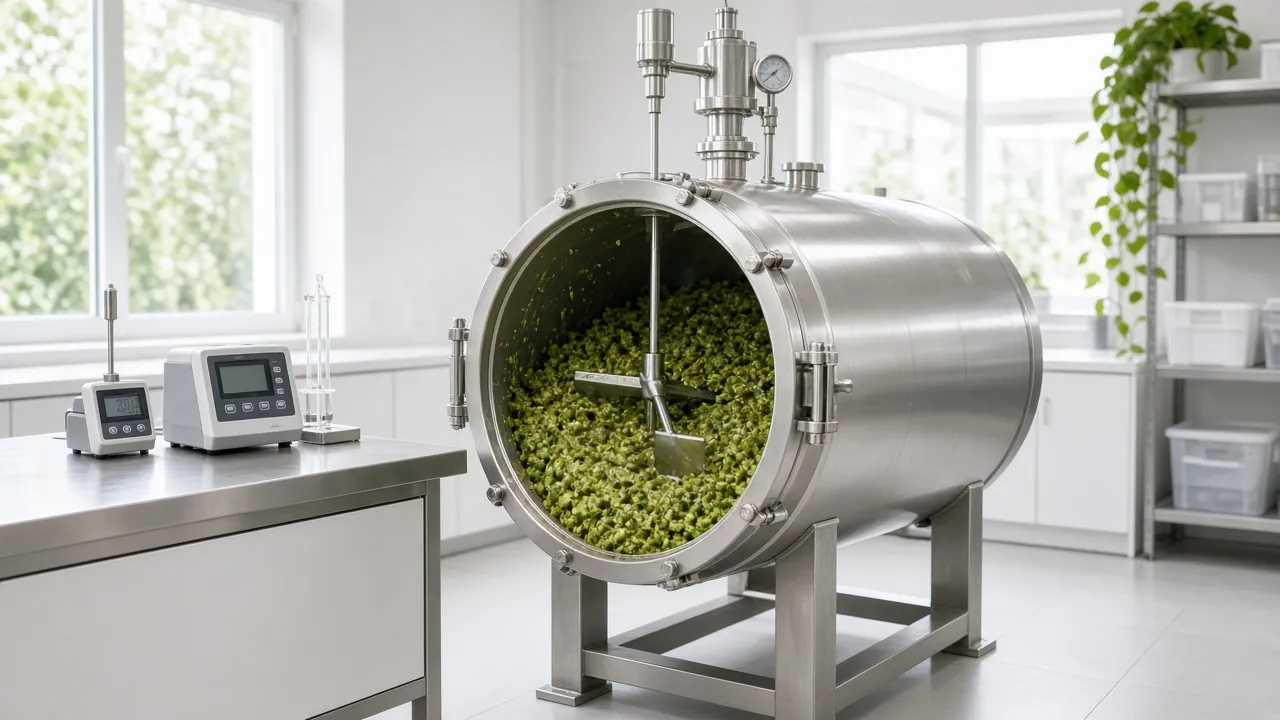 Illustrative image · not KupuriBiotech equipment
Calculator
From dry-matter basis to a tonne of fresh feed
Move the sliders to convert a dry-matter value into crude protein per tonne or short ton of fresh feed. The arithmetic uses literature values; it is not a result from the pilot.
Presets, rounded to the slider steps: fresh pad, averages from a feed database1; trial A, crude protein after 24 h with yeast and added nitrogen4; trial B, a semi-solid fermentation with added nitrogen3.
% fresh = CP % DM × DM % / 100 · kg/t = % fresh × 10 · lb/short ton = % fresh × 20 · lb/short ton DM = CP % DM × 20.
The science · Yields
From published rainfed ranges to our internal projections.
A published rainfed reference compared with KupuriBiotech’s internal planning projections under drip irrigation.
Yield is the figure everyone asks about first, and the one we treat with the most care. Under rainfall alone, a Mexican technical sheet reports about 22 tonnes of fresh (green) forage per hectare per year once the stand is established (≈ 9.8 short tons per acre), at 1,250 plants per hectare5; Mexican forage-nopal yields are reported to average about 20.5 t/ha3. Our planning assumes a very different system: drip irrigation, fertility set from soil analysis, and a planting density chosen for repeated cutting.
Internal planning projections, not measured and not guaranteed: about 65 t/ha (29 short tons per acre) in year 2 and about 160 t/ha (71 short tons per acre) in year 3, after a first year devoted to establishment with no committed yield. They assume drip irrigation, fertility set from the soil test, 20,000 pads per hectare (≈ 8,094 per acre), cuts every 3–4 months by regrowth (a planning assumption, to be tested; published practice usually cuts far less often67) and no major freeze loss. Published work reports yields of this order only under intensive management, such as about 160 t/ha per year of fresh nopal3 or 100–400 t of pads per hectare per year in high-density plantings with inputs6, and in some cases only in later years of the stand. Actual results may be substantially lower and will replace these figures as soon as the first harvests are weighed.
Fresh yield per year
Fresh matter · conversion: short ton/acre = t/ha × 0.44609
| Stage | t/ha/yr | short ton/ac/yr |
|---|---|---|
| Rainfed reference Literature | ≈ 225 | ≈ 9.8 |
| Year 1 · establishment Projection | not committed | not committed |
| Year 2 · internal projection (not measured) Projection | ≈ 65 | ≈ 29.0 |
| Year 3 · internal projection (not measured) Projection | ≈ 160 | ≈ 71.4 |
Conversions: 1 ha = 2.47105 acres; 1 metric tonne = 2,204.62 lb; 1 short ton = 2,000 lb; short ton/acre = t/ha × 0.44609.
FAQ
Frequently asked questions.
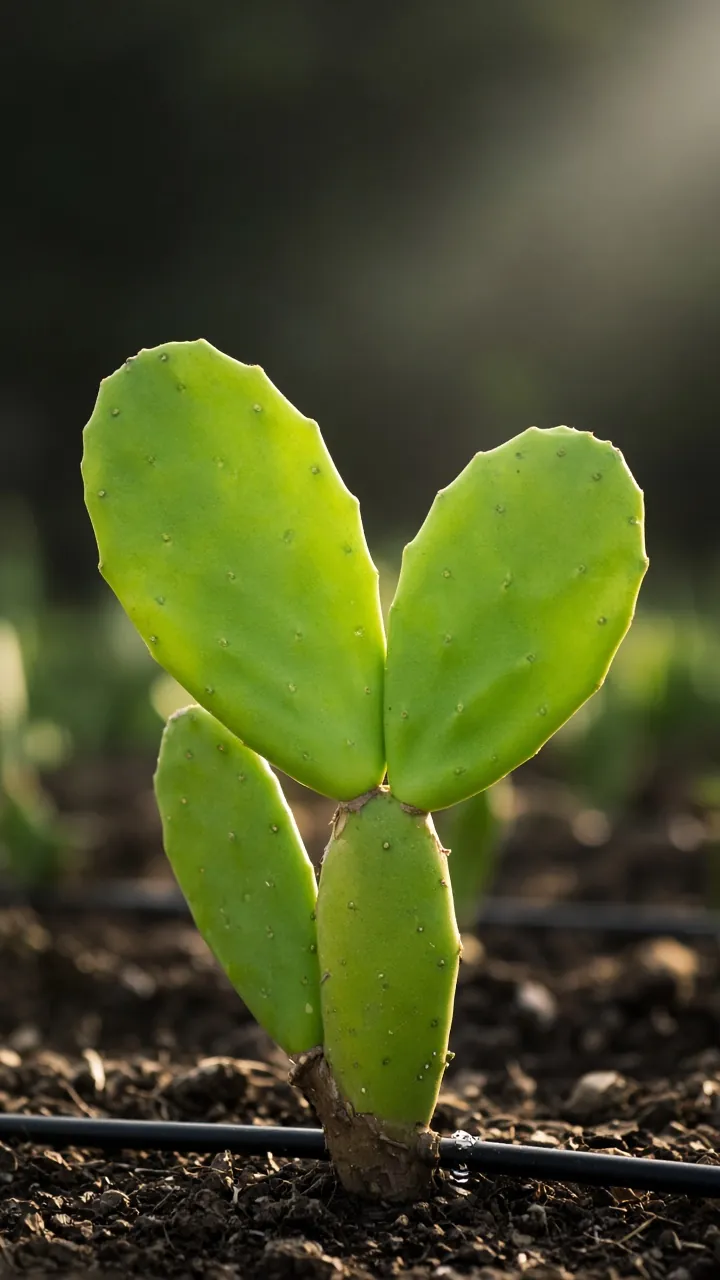 Illustrative image
Is forage nopal new?
No. In Mexico nopal has been grown and eaten for thousands of years, and ranchers, universities and public programs there grow forage nopal and feed it to livestock today. Our role is to learn from that work and bring it, with measured data, to South Texas.
Is forage nopal drought-proof?
No. It is water-efficient, not water-independent. It uses water sparingly and tolerates dry spells, but the highest yields in the literature come from irrigated, fertilized stands62.
Are the pads really spineless?
Spineless forage types carry far fewer spines than wild nopal, but small spines and fine glochids may remain; botanical descriptions of the spineless type mention occasional spines 0.5–1.0 cm (0.2–0.4 in) long and glochids that fall away early2. Handling with gloves is still advised.
Do cattle need the nopal to be fermented?
No. Ruminants can eat spineless nopal fresh, chopped and mixed with dry forage. Fermentation is an optional enrichment step, not a requirement.
Does fermentation turn nopal into a high-protein feed?
Published trials report crude protein rising from about 5–7% to about 23–34% of dry matter34. Most of that rise comes from the nitrogen that is added, and crude protein counts non-protein nitrogen as if it were protein. The yeast can convert part of it into true protein, but how much has to be measured. This is not feeding advice.
How long does fermented nopal keep?
Not long. In one published trial crude protein was already falling by 24 hours, and the authors advise fermenting for no more than 24 hours4; KupuriBiotech makes no storage claim for it. Whole pads keep better than chopped or fermented material.
How much nopal can sheep eat?
In published lamb trials summarized by FAO, cactus made up about 28–70% of the diet dry matter, alongside straw or hay2. That is a literature reference, not a ration recommendation; consult a qualified nutritionist.
Are the yields on this page measured in Texas?
Not yet. The rainfed figure is a published literature reference, and the year 2 and year 3 values are KupuriBiotech internal projections, not measured or guaranteed, to be checked at the pilot.
When is the first harvest?
Nothing is planted yet. The date of the first cut is to be confirmed at the pilot. For reference, a Mexican rainfed technical sheet starts cutting six months to a year after planting5, and an irrigated trial compared first cuts at 4, 8, 12 and 16 months, with more forage at the longer intervals7.
Is KupuriBiotech selling forage or products today?
No. KupuriBiotech is not operating and does not sell forage or any other product. This site is general information about a planned pilot, not a commercial or investment offer.
Whose knowledge is this?
Forage nopal belongs to a long Mexican tradition and to the many ranchers, universities and public programs that work with it today. Published research is our bibliography. We plan to measure in our own field and to say plainly where every figure comes from.
Sources
Numbered references for the literature figures on this page. Each was checked against the page or table shown. KupuriBiotech internal projections are not literature and carry no reference.
- Heuzé V. and Tran G. (2017). Prickly pear (Opuntia ficus-indica). Feedipedia, a programme by INRAE, CIRAD, AFZ and FAO. Table “Prickly pear, cladodes, fresh”. https://www.feedipedia.org/node/120.
- Inglese P., Mondragón C., Nefzaoui A. and Sáenz C. (eds.) (2017). Crop ecology, cultivation and uses of cactus pear. FAO and ICARDA, Rome. ISBN 978-92-5-109860-8. https://www.fao.org/4/i7628en/I7628EN.pdf. Cited at: p. 19; p. 82; p. 83; Table 4, p. 84.
- Flores Hernández A. et al. (2019). Fermentación semisólida del nopal (Opuntia spp.) para su uso como complemento proteico animal. Revista de Geografía Agrícola 63: 87–100. https://doi.org/10.5154/r.rga.2019.63.04. Cited at: p. 87; p. 89; Table 1, p. 93; pp. 94–95; p. 94.
- Maldonado-Quiñones H. J. et al. (2022). Calidad nutritiva y densidad microbiana de nopal duraznillo (Opuntia leucotricha) fermentado en estado sólido. Acta Universitaria 32, e3559. https://doi.org/10.15174/au.2022.3559. Cited at: p. 8; Tables 3 and 5, pp. 8–10; Table 5, p. 10; p. 11; p. 13.
- Medina García G., Salinas González H. and Rubio Aguirre F. A. (2001). Potencial productivo de especies forrajeras en el estado de Zacatecas. INIFAP, Libro Técnico No. 1. Technical sheet “Nopal forrajero, temporal” (rainfed forage nopal). https://zacatecas.inifap.gob.mx/publicaciones/Pot_Prod_de_Especies_Forrajeras_en_Zacatecas.pdf. Cited at: p. 54.
- Martínez Hernández J. de J. (2023). Manual técnico del nopal: plantación y manejo agronómico del nopal forrajero en zonas áridas. Comisión Nacional de las Zonas Áridas (CONAZA), Mexico. https://0201.nccdn.net/1_2/000/000/116/883/manual-nopal.pdf. Cited at: p. 14; p. 30; p. 40.
- Rocha R. S., Voltolini T. V. and Gava C. A. T. (2017). Características produtivas e estruturais de genótipos de palma forrageira irrigada em diferentes intervalos de corte. Archivos de Zootecnia 66(255): 363–371. DOI 10.21071/az.v66i255.2512. https://www.alice.cnptia.embrapa.br/alice/bitstream/doc/1085862/1/Tadeu2017.pdf. Cited at: p. 364; Table II, p. 366.